When Did Liverpool Win the Champions League? Their Journey to European Glory
Liverpool is one of the most historically significant clubs in European football, with a remarkable Champions League history shaped by generations of players and matches that have become classics. When exploring when Liverpool won the Champions League, fans will realize that The Reds’ journey was built not only on trophies, but also on competitive resilience, tactical adaptability, and a distinctive fighting spirit.
An Overview of Liverpool’s Journey to European Glory
If the question is when Liverpool won the Champions League, the complete answer includes six seasons rather than just one date. The first four came when the competition was still known as the European Cup, before it was restructured and renamed the UEFA Champions League. The two most recent titles came in 2005 and 2019, creating two memorable chapters filled with emotional performances.

Pitch familiarity and stadium atmosphere may matter too, but their impact varies from team to team and from one competition to another. A packed stadium for a derby, for example, creates a very different environment from a quiet midweek fixture.
So for football betting, it makes more sense to treat home advantage as one part of the matchup rather than an automatic boost for the home team.
Why a Strong Home Record Can Be Misleading
A record of seven wins from ten home games looks impressive, but the opposition behind those results matters. Beating several teams near the bottom of the table tells us something different from beating strong sides competing for the title or European places.
The schedule can also create misleading splits. A team may face tougher opponents away from home, making its home record look unusually strong by comparison.
Results alone can miss another layer. A team might win regularly at home without consistently dominating chances, while relying on efficient finishing or narrow margins. Looking at xG, xGA, big chances and shot quality alongside the results gives a better idea of whether the home record reflects sustained performance or simply a favourable run.
Home Performance vs Away Performance
One of the easiest ways to judge how much home advantage actually matters is to compare a team’s numbers at home with its away performance. Start with xG and xGA, then look at goals, shots and big chances created and conceded. The gap between those numbers can tell you whether a team genuinely performs better in its own stadium or simply has a better-looking home record.
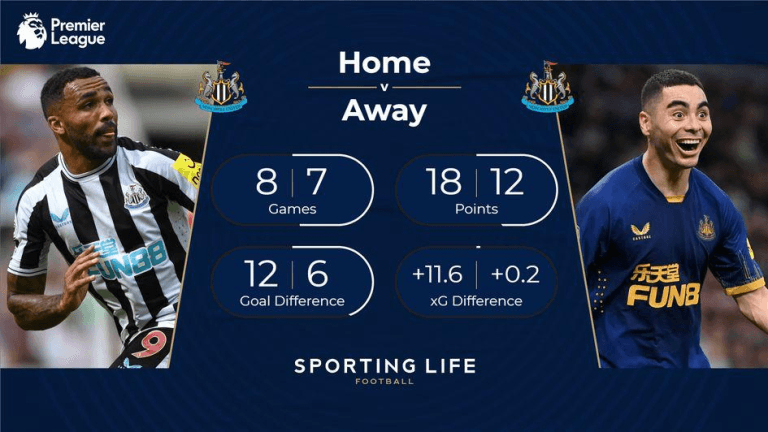
For example, a team might average 1.8 xG and 0.9 xGA at home but only 1.1 xG and 1.5 xGA away. That is a meaningful split: the team is creating more and giving up less when playing in familiar surroundings.
The same logic applies in reverse. Some sides are comfortable playing on the counter away from home and may actually produce similar chance numbers on the road.
That is why W-D-L alone can be misleading. Two teams could both have six home wins, but one may consistently control games and create better chances, while the other survives through late goals and narrow margins. Comparing the underlying numbers gives a clearer picture of how a team actually performs in each setting.
Travel and Schedule Can Change the Equation
Home advantage can become more noticeable when the away team has had a demanding schedule. Travel distance, short rest periods and midweek fixtures can all affect preparation and physical freshness, particularly when matches come close together.
This becomes more relevant for teams competing in European competitions or international tournaments. A side returning from an away game several hundred kilometres away and playing again after three days may not arrive with the same energy as it would after a full week of preparation.
The important point is not to assume that travel automatically makes a team weaker. Instead, check how much recovery time each side has had and what their recent schedule looks like. A team with a deep squad may cope comfortably with fixture congestion, while another could struggle when several matches are packed into a short period.
For football betting analysis, this context can help explain why the same home advantage may carry more weight in one matchup than another.

When Home Advantage Matters Less
Home advantage is not equally important in every match. It can carry less weight when a game is played at a neutral venue, or when the stadium has a low attendance and the usual home crowd effect is limited. The same applies to certain derby or high-pressure fixtures, where familiarity with the venue can be outweighed by the intensity and tactical approach of the match.
The quality gap between the teams also matters. If the away side is significantly stronger and has a consistently good away record, simply playing at home may not change the overall balance very much.
This is why the home label should always be viewed in context. A strong home team facing an excellent away side is a different proposition from the same team hosting a struggling opponent.
How to Use Home Advantage in Football Betting
The biggest mistake is turning “home team” into an automatic pick. Instead, start by comparing the team’s home numbers with the opponent’s away performance. Then add opponent quality, recent performance and squad availability to the picture.
The next step is to look at the odds. Home advantage is already one of the factors reflected in the market price, so the question is not simply whether the home side has an edge, but whether the available price appears to account for that edge. Platforms such as M88 can provide a useful reference point for seeing how the market prices a matchup alongside the football statistics.
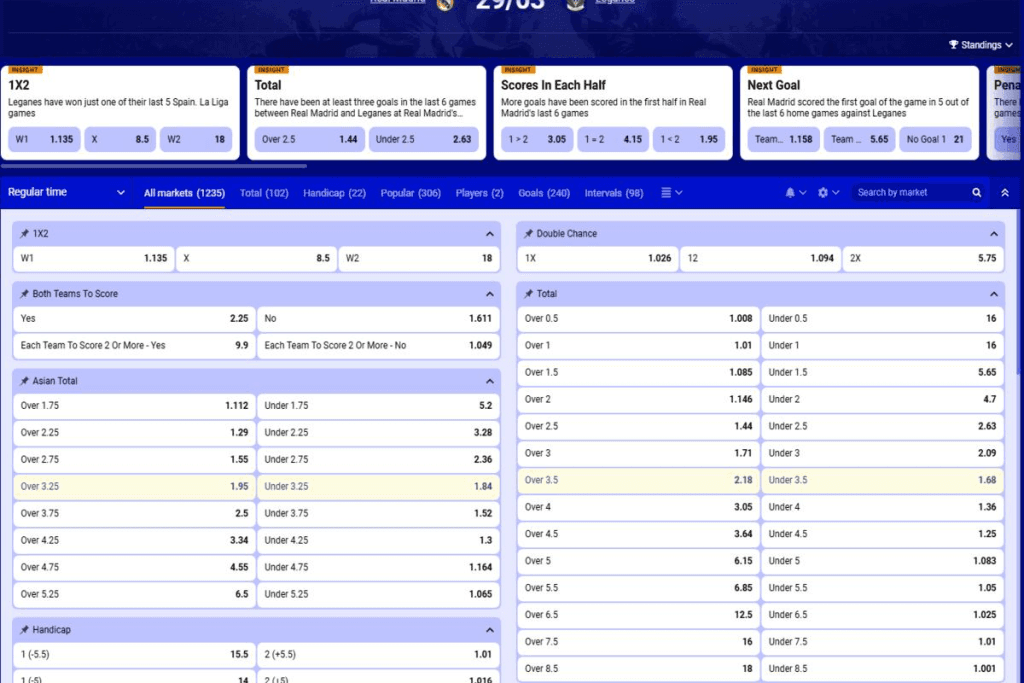
Still, odds should be treated as market information, not proof that a particular outcome will happen. The most useful approach is to bring the home/away split, underlying performance and match context together before drawing your own conclusion.
A Simple Framework for Reading Home Advantage
Rather than treating home advantage as a single number, readers can break it down into six simple checks:
Home performance → Away performance → Opponent quality → Chance quality → Rest/travel → Market odds
Start with home performance. Check the team’s xG, xGA, goals, shots and big chances in home games instead of looking only at wins and losses. This shows whether the team actually performs better in its own stadium.
Next, look at the opponent’s away performance. A team with a strong away record and solid underlying numbers may reduce the practical value of home advantage.
Then consider opponent quality. A home record built mainly against weaker teams should not be compared directly with one achieved against top-level opposition.
After that, check chance quality. xG, big chances and xG per shot can reveal whether the team is creating genuinely dangerous opportunities or simply taking plenty of low-quality attempts.
Finally, factor in rest and travel. Short recovery periods, midweek games and long journeys can influence how fresh both sides are. Only after considering these factors should you look at the market odds and ask whether the home advantage appears to be fully reflected in the price.
Conclusion
Home advantage is real, but it is not a fixed bonus that should be added automatically whenever a team plays in its own stadium. Its impact depends on the team’s actual home performance, the opponent’s away record, the quality of chances being created, squad availability and the demands of the schedule.
That is why a simple home win percentage rarely tells the full story. A team may have an excellent home record but face a difficult opponent with a strong away profile, while another home side may have fewer wins but consistently produce better underlying numbers.
For football betting analysis, the useful question is therefore not simply “Who is playing at home?” It is “What does the home setting actually change in this particular matchup?” Looking at the numbers and the context together gives a much clearer picture than relying on the home label alone.